The failure of state-run secondary schools exacerbates classism as a result of mismanagement and social neglect by persistent administrations that have had a piece-meal approach to the crises yutes face in the education system.
For 2015, in the allocation pool of 443 national scholarships, denominational schools took home a whopping 95% of the total number of scholarships.
This issue calls for being more than a “very concerned” Minister of Education or having the Cabinet of Trinidad and Tobago more than “not pleased” with the outcome. These unsatisfactory responses go against the history of struggle of teachers unions and the early nation building efforts. Together, they fought to democratise education while challenging elitism that blocked greater access to and standardisation of schools.
The fact that adults in their 40s, 50s and 60s continually identify with their alma matter and wear gold and seilver secondary school rings in job interviews express what kinds of social advantages come with attending a prestige school, which is almost exclusively a denominational school. Clearly, our education at the secondary school level is part of the social class fabric of Trinidad and Tobago society; it enables a social hierarchy of power and privilege, that helps people procure social goods and services in the medium and long-term, and others have less access to it.
Directly related to this is the annual photo opportunity with Ministers of Education who visit the top performing school in S.E.A examinations, this is a validation of the “primary school winner” in a competitive exam race yutes are pushed to participate in for anxious placement in schools. While it is important for us to celebrate excellence, there is no public reminder and commitment to the improvement of the students who do not make the “Top 100.”
There is another dimesnion. Sixth Form is for yutes who want to be in school. There is greater national visibility on their performance since scholarships are awarded. Form Five is for the yutes who have to be in school. There is much less visibility on success and failure at CSEC O’Level examinations. There are alarming failure rates in Math and English for boys and girls, and this brings more truth about the crumbling government school system than Sixth Form school performance.
I look forward to a Government of the Republic of Trinidad and Tobago that initiates research to address this question: How many 6th formers on national scholarship did private lessons? “Factory lessons” which provide intense programmes for exam preparations and a guide on “how to get a scholarship” is a major characteristic of school life for yutes today. Essentially, rich, poor and middle class parents dig deep into their pockets to pay for a second secondary school education that runs parallel to the official school programme. Teachers involved in the school system often lead these lessons, and it even happens at an equally petrifying scale at the primary school level.
The same way a classless Trinidad and Tobago is a myth, so is there a cultural mythology that those who do not do well are lazy, undisciplined or had a choice in being “left behind.” How convenient is it for the Minister responsible for Education to lobby for a national discussion on corporal punishment now? To make it short, our problem in education today is not primarily an issue of child discipline. I argue it is one of political will and resources to address the issue of the under-investment in state-run secondary schools; weak and infrequent Parent Teachers Associations strapped for cash; the pervasiveness of community violence that creates school yards as battle grounds; an economy that values academia over “trades” (in spite of how much lip service and paper qualifications we encourage); and, the lack of affirming social environments for yutes to lift their head in confidence and not get beat down in the home, beat down in the community, beat down in the streets when the system beats them Monday through Friday in a classroom.
A national consultation on the quality of education at all levels should rollout in every educational parish. What possibilities lie for UTT and UWI making clinical interventions into the school system? Foreign language, culinary and creative arts schools are on the horizon? How about confronting the issue of “fly-away-ism” where our students dream to study, work and live away as far as possible from Trinidad and Tobago? Their educational drive is stimulated by the prospect of “flying out.”
I honour the hard work all students on scholarship have put in. My younger brother, Marcus, literally beat book, worked in study groups and did tutorial style sessions with students in lower forms to reinforce what he knew and later reaped the rewards. He also did lessons. I think persons have more advanced learning curves than some; but to do well in exams requires a bold standard of consistent output, hard work.
An expansion of the number of scholarships does not fix the mass of yutes structurally fixed to the bottom of the education pyramid. On this road to development into 2020, 2030, 2100, we may be going “up the down escalator”, as Michael Manley remarked, if we are not serious about who is moving through with possibility in the development process.
This is about the right to raise our children in dignity and good health; this is about the right to give equal life chances for any student and chile placed in a school they ‘passed for’ in an exam that they sat since they were 11.
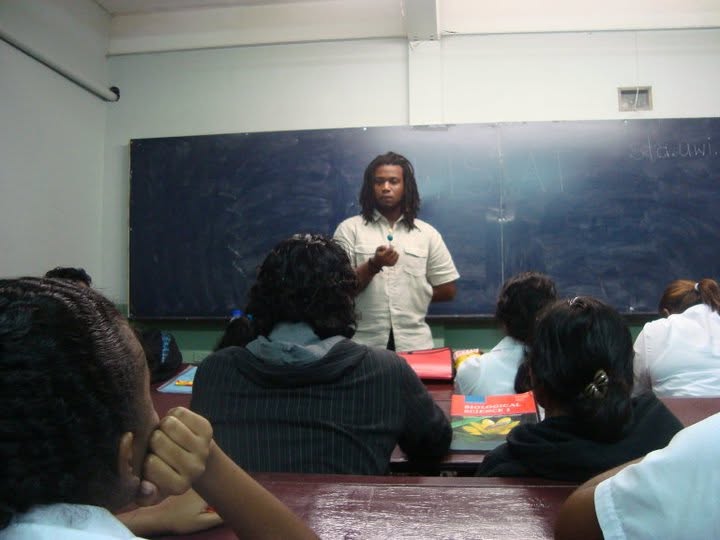
Blog Feature Image, School Visit to St. Augustine Community College, UWI STAT Youth Talks, 2010


One thought on “Classism 101: How the State Fails Our Children”
Comments are closed.